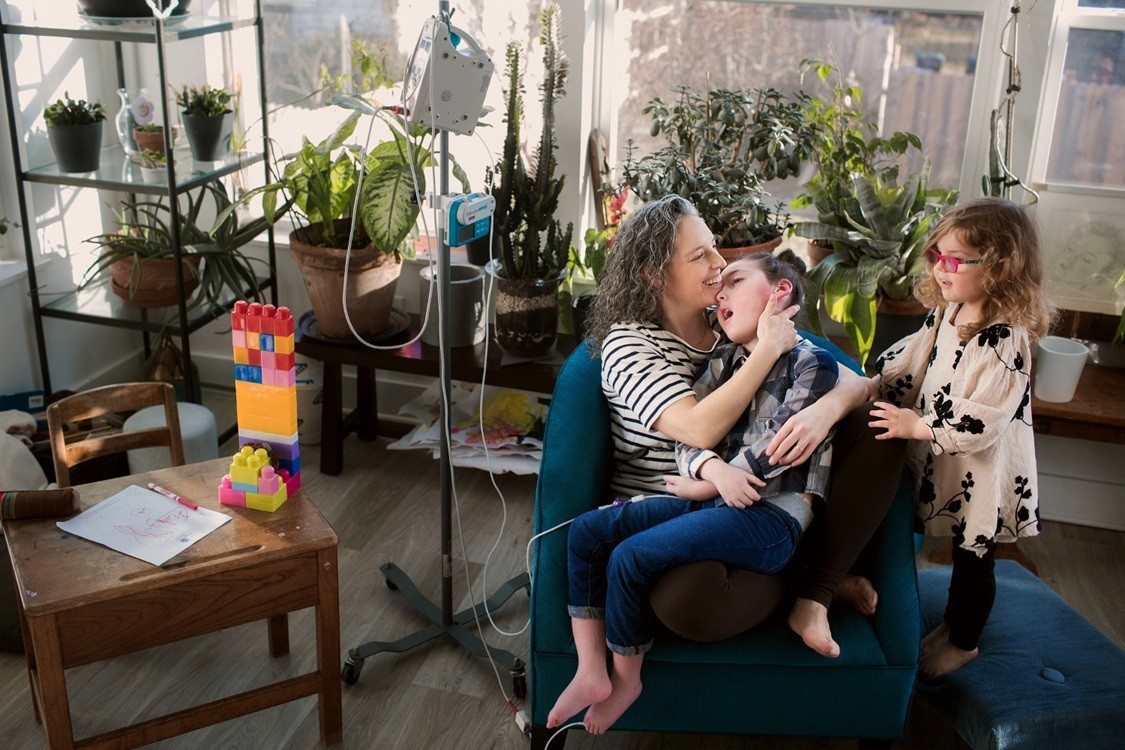
Gabrielle Conecker, caregiver’s perspective
“Exhausting and an honor”: Caring for Elliott and leading the change across the DEEs
Gabrielle Conecker is the mother of 13-year-old Elliott, who lives with SCN8A, a developmental and epileptic encephalopathy (DEE). From day one of Elliott’s life, with seizures and thousands of hours spent in the hospital, the family’s reality has been relentless – and so has Gabi’s drive to change it.
Elliott was born having seizures on the first day of life. His parents kept noticing suspicious movements, but their pediatrician said, ‘It’s fine’, and despite their persistent questioning, the spasms went undiagnosed for months.
’When I googled Elliott’s mutation, Google literally said: ”We have no results for you”,’ says Gabi, who is a full-time caregiver for Elliott. It was only in 2012 that SCN8A was first linked to pediatric epilepsy.
Care that never clocks out
Living with SCN8A, which can impact many systems, Elliott faces multiple challenges. A major one is hypotonia, which is low muscle tone affecting his ability to move independently and the function of many of his internal organs. For example, when Elliott gets sick, he cannot cough, and he often ends up in intensive care, intubated and sedated.
In addition to respiratory difficulties, Elliott also struggles with bladder issues, GI issues, vision impairment, and the inability to easily communicate what he needs or how he is feeling. Gabi and her husband are vigilant – 24/7 every day of the year. There is no vacation from SCN8A and other DEEs.
’I still mask everywhere because we cannot risk another hospitalization,’ says Gabi and continues:
’Our days are packed. Often, we feel more like nurses and therapists than mom and dad, but if I had to tell the world one thing, it is that caregiving for Elliott is exhausting – and an honor.’
’Behind every milestone we hoped for, there was another challenge. We kept going.’
Gabrielle Conecker
From powerless to purposeful
At the time of diagnosis, Elliott’s parents found them-selves alone. There was no group to join, no clinical evidence, no prognosis, nothing.
Establishing weekly ‘citizen scientists’ meetings gathering real-world data and sharing back practical guidance to families living with SCN8A is one of the cornerstones of the work Gabi leads at the International SCN8A Alliance.
The SCN8A Alliance team has led many critical efforts to move the SCN8A field forward, including the development of a 10-year longitudinal SCN8A Registry, the first consensus on the diagnosis and treatment of SCN8A, and most recently, an inaugural SCN8A Research Roadmap that identifies critical gaps in SCN8A and a path to address them. These, among other efforts, have led to two clinical trials for the disorder in less than 10 years.
Resilience, hope – and partners
Elliott’s spirit is the main thing that keeps the couple going:
‘I cannot think of a stronger human being than our kid,’ says Gabi.
’There is little I can do to completely stop seizures, but I believe advocacy is where I truly can have an impact. What I want to see is faster translation and data-sharing so learning reaches patients sooner,’ says Gabi, referring to her enormous efforts to advance improved treatments for SCN8A and other DEEs.
’With better tools and true collaboration, we will get there faster.’
When rare is shared
Additionally, Gabi helped create another collaborative effort called DEE-P Connections, which brings together more than 50 DEE patient advocacy groups to provide targeted resources to caregivers of children living with these disorders, empower them to be powerful advocates for their children, and engage them in critical research efforts to collectively advance treatments for the DEEs.
Their largest research effort The Inchstone Project – brings together caregivers, researchers, clinicians, and industry partners working together to break down barriers that limit clinical trial inclusion and ensure there are clinical trial assessment measures that can capture the small but meaningful inchstones of progress those with DEEs make. Ultimately, this work will be critical to ensuring that treatments which bring meaningful change to the broad community of those living with DEEs are brought to market.
SCN8A-DEE
SCN8A developmental and epileptic encephalopathy (SCN8A-DEE) is a severe genetic disorder. It is caused by mutations in the SCN8A gene, which leads to epilepsy, intellectual disability, and developmental delay or regression, often starting in infancy.